Wednesday, February 28, 2018

Let's prove our knowledge and learn about metacognition!


Wednesday 28th

On the 1st hour of the class we have a kind of an exam, it was a Kahoot. Kahoot is a game-based learning platform, used as educational technology in classrooms and other learning institutions, are multiple-choice quizzes that allow user generation and can be accessed via web browser. 

The kahoot was about the topic of the group of experts activity. I realized that I did not understand some things very well because I was wrong in several questions, but the teacher explained us the questions, so now I have a clearer idea.

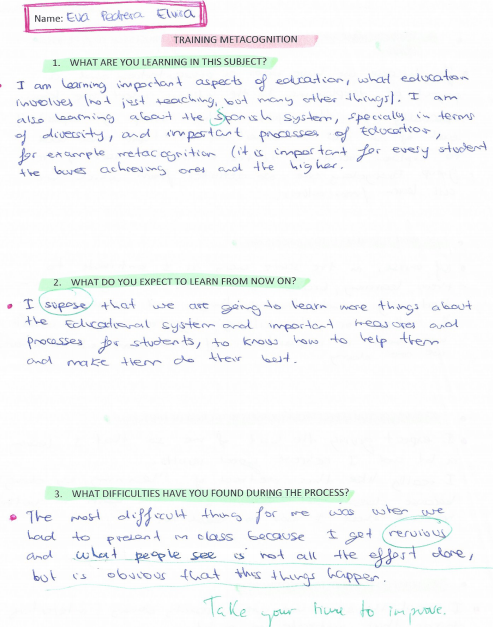
And on the 2nd hour we did an activity on Metacognition, first of all, we answered some questions about this topic, to try to understand what metacognition is without the teacher telling it to us. Then, he gave us a photocopy that talks about metacognition, we read it aloud and then by pairs we did a summary and he asked questions to us.

Here you have my first impression of metacognition, the photocopy and the summary we made: 


Monday, February 26, 2018

Today I am a journalist!


Monday 26th

We have done an activity among the 2 hours of the class: writing an article as if we were journalists. The topic of the article was if the Spanish Education System is prepared for attending diversity or not.

First of all I started organising my ideas through brainstorming: writing whatever I think when I read the topic. I prepared a draft in my computer, and when forty minutes left, I passed it to the sheet that I was going to deliver the teacher.

For doing it, the tracher allowed us to use the information given when we did the experts’ activity about guidance and counselling; that talked about specific measures. This information helped me for explaining the theory part on my article.

I liked this activity because I like very much writing, specially about topics that interest me and in which I can translate my opinion.

I leave you here my article, where, as I have just say, you will see my opinion and some important ideas of Spanish Measures when talking about diversity.


As you can see the teacher put me a 7, and told me that was a good job. I am happy with my mark but I am a very nonconformist person, so next time I will try to do a better job for acquiring a better mark.

Wednesday, February 21, 2018

Expert for one day!


Wednesday 21st

In today's lesson we have done an activity called "Group of experts" where the collaborative methodology was used.The aim of this activity is to focus in the Spanish context what we have learned in general about School Guidance and Counselling.

The whole class was divided into 5 groups. Each group was composed by an expert of one of the topics related to Guidance and Counseling. The topics were:

         1.Spain: Guidance and Counselling in Early Childhood
         2. Spain: Guidance and Counselling in Higher Education
         3. Spain: Guidance and Counselling in a Lifelong Learning Approach
         4. Spain: Support Measures for Learners in Adult Education and Training

Each expert received a document with the information about their topic, which is the necessary information to become an expert. They did not read this information on their own, all the experts on topic one got together and those from topic two and like that from all four topics. They understood and learned the information, and decided the best way to explain it to the members of their group.

Once all experts had their information clear they went back to their original groups, where they had to explain their topic. During the explanation the members of the group took notes or asked questions in order to get as much information as possible from them.

I think this is a great activity to do because apart from the fact that it is a collaborative activity, it is also dynamic, and everyone has an important role and responsibility, which is to inform his group members. For the moment I think it has been my favorite class, because I learned a lot.


I attach here a summary of every topic: 


EXPERT 1.

Ordinary measures have two main impacts:


On the general organization of the school: for instance, the organization of the students groups, the use of spaces strategies favoring universal accessibility and allowing students’ participation in learning (ramps, early dropout preventions…), tutor guidance and action and the collaborative work and cooperation of the professionals working inside the school, the external agents (stakeholders) and the families.

   - On the prevention and detection of learning difficulties: these measures involve an individualized attention of the students, through reinforcement and support mechanisms, adaptation of different learning rhythms, support in classroom with group splitting and flexible grouping and the implementation of different resources and methodological strategies. Another way of preventing and detecting these difficulties could be the non-meaningful curricular adaptations, activities for the evaluation of these children, curricular material adaptation and help with the optional subjects expected in Lower Compulsory Secondary Education.

- Non-meaningful curricular adaptations à modifications that we make in the program that does not affect the curriculum.


EXPERT 2.


Extraordinary measures are aimed for students with specific education needs, it is need a previous diagnose through a psycho-pedagogic evaluation, and a continuous monitoring for adapting the decisions taken. These measures are only applied in compulsory education.

Measures and its characteristics:


- Meaningful curricular adaptations: Essential aspects are modified (objectives, contents and evaluation criteria).

- Curricular diversification programs: Students for 3rd and 4th of ESO. Purpose is to reach de general objectives and obtain lower compulsory secondary education certificate. Organized in 2 fields: scientific/technological and social/linguistic.

- Basic vocational training: New basic vocational training cycles, to students between 15 and 17 years, that have completed the first cycle of compulsory secondary education.

- Programs to improve learning and performance: Aimed for students with relevant learning difficulties, from the 2nd year of ESO. It uses a specific methodology like practical activities and if it is necessary, different subjects from the ones generally stablished. Can be organized in an integrated way, in 3 specific fields: linguistic/social, scientific/mathematical and foreign languages.

- Making the stay in the education level more flexible: To know each student and make possible to adapt the education.


EXPERT 3


Measures for students with special educational needs related to disability or severe conduct disorder. We find certain measures for students with disabilities or disorders: meaningful curricular adaptations: modifying the essential aspects and having support teachers. Significant curricular modification: changes in the curriculum so that these students, beside their difficulties can study the ordinary curriculum. Classrooms for special education in mainstream education: try to favor their social adaptation and integration. Reduction in the number of students per classroom. Support by specialized teachers, depending. Making the satay in the education level more flexible: so, students with special education needs can stay in the education level one year or more than the expected for the other students.


EXPERT 4


Extraordinary measures

They are only applied in compulsory education. To apply these measures, we should follow three steps: diagnose, adaptation and monitoring. We apply these extraordinary measures sin some cases:

Students with learning difficulties: we apply the measures in core subjects and we apply them to attend students related to insignificant curricular modification and methodological strategies.

Highly gifted students: make the stay level more flexible, anticipating schooling or reducing its length.

Students entering late the educational system: plans and programs are designed and measures are developed which must ensure that the education of these students is made in response to circumstances. They are integrated into specific programs aimed at meeting the linguistic deficiencies.

Programs and plans
:

-Hosting programs and plans:
 introduce the school to the arrival of new students
-Programs and plans for teaching the language of the host society: two types: - language classroom: provide students with the linguistic competence. -linguistic and curricular reinforcement actions: facilitate the study.
-Programs for teaching the language and culture of the country origin: extracurricular activities to give the opportunity of continuing studying native language to the students from other countries.
  
Measures:

-Information for immigrant families on the Spanish Education System in several languages.
-Support services for intercultural mediation, and translating and interpreting services
-Measures supporting the teaching function.
-Making stay at the educational level more flexible.
-Reduction of groups’ size in the classroom 

Monday, February 19, 2018

WebQuest!


Wednesday 7th

Today the teacher explained us our first presentation. This presentation is to understand more in deep what “School Guidance and Counselling is”, he gave us eight questions that we will have to understand and explain in a presentation. He also gave us the material for finding this information.

                             The questions were these ones:

-What is school guidance counselling?
 -What are its functions and its main areas?
-Who receives the school guidance and counselling services?
 -What services are provided in the school guidance and counselling programmes?
-Who provides these services?
-When are the school guidance counselling services provided?
-Where are they provided?


We read the information and saw the videos Miguel gave us for understanding the topic and then my group and I tried to answer the questions. As we are four, we divide ourselves in pairs for distributing the time and having time to finish looking up all the information. What we intend is to explain to each other what we have understood in order to understand perfectly all the questions, even those that the other pair answered.

Monday 12th
Today we all explained what we had understood to see if we had a similar idea and that's how it was. In addition we review all the questions and look for more information apart that we could add to the presentation.

We start preparing a Prezi, because we will present mainly relying on images. We did not finish the Prezi, so we will finish it this afternoon to have everything ready for Wednesday, the day of the presentation! We are group one, so we present the first!!

Wednesday 14th
The teacher did not come to class, so we did not present, the presentations are postponed to Monday 19.

Monday 19th
Presentations about School Guidance and Counselling. My group was the first one presenting and we were really nervious, we think that it came out much worse than it should have been for all the work we did, but these things can happen, we hope next time is better.

The teacher asked us what mark we would put ourselves, we think that a 7 or 8, because the mark should not only reflect what it is seen, but all the work behind. He said that if he had to put any mark on us it would be a 7.

I listened to the presentations of all my classmates and I think we all worked a lot and it was good, although all the presentations went about the same thing it did not become very tough.

I leave you here our prezi with all the developed questions: https://prezi.com/view/d57wNLLZ1kZjIl2WcNyt/ 


Monday, February 5, 2018

Let's think....1, 2, 4 method

Monday 5th 

Today is the first day of class, as normally, the teacher has presented himself and he told us how he normally organise the semester: learning by doing. No exams, but projects and presentations that he will explain as the occasion arises.

What I liked the most was that he did not tell us that that was going to be the method, but if it seemed good to the whole class it would be.

Usually the student's opinion is not heard for this type of decisions, and I thought it was very good for him. we liked the idea of organizing the semester like this, although we were a bit misplaced because we are not used to it, he told us that it was normal and that little by little we would catch the method and we would get used to it.

When we have a new subject we do not even understand the name of it, we do not know what we will learn or what it is going. Moreover, many times we do not stop to think about it until the teacher arrives and says: "in this subject we will learn blablabla".

Okay, so this time it was not like that, we had to think a bit of exactly what is: “Orientación Educativa y Acción Tutorial” and its translation to english. For this, We did the 1,2,4 method. This is: first we tried to define it individually, then in pairs and finally in groups of four.

Nobody came up with the concrete translation, although we all got a little closer, mines was: “Educational Guidance and tutorship”. And my definition: ‘A subject where we are going to learn important things about how teaching and what teaching involves, and the relation of teachers and students.’

Then we saw two videos, one of Rita Pierson: ‘Todo niño necesita un campeón’ (https://cv4.ucm.es/moodle/mod/url/view.php?id=3156840), and other of Emilio Lledó (https://cv4.ucm.es/moodle/mod/url/view.php?id=3156844). I liked the videos, and of the second one I wrote some interesting quotes he said, but my favourite one was: ‘Los seres humanos aman más que odian’. After watching the videos we add things to our definitions so that they were more complete, I added the importance of showing in schools freedom of thought, values, ethics and  attitudes, teaching is just a part of education, for having education we need many other aspects.

My definition in pairs was: ‘A subject in which we will learn that there are different perspectives of understanding education, becoming concious of what education involves: more than teaching (freedom of thought, ethics, human relationships and attitudes.

And our definition in groups of four was almost the same as the one in pairs, because when we were going to put our pair definitions is common we realize that we were saying the same but with other words.

After all this work, we now know many more things than before. The last activity we did was putting into common among the hole class, every group went to the blackboard and wrote two key words of our definitions, and at the end the words were these ones: perspectives, critical thinking, to guide, freedom, relationships, values, human flourishing, care, showing and communication.

So, in conclusion today I have learned that education is not just teaching,  it is more than that.